Showing posts with label Strange Tales. Show all posts

Saturday, June 23, 2007

Accused by a Dead Man's Head

Gabris Rabinski looked across the courtroom to the judge and jury. He stifled a smug smile. He was about to get away with murder. A labourer on a farm in upstate New York, he had been in love with a girl on the farm. A fellow labourer, Thomas Maika, had also been sweet on her, and when Rabinski had seen her kissing Maika, he had waited until Maika was alone, then beaten his colleague's head in. He had been caught, but only hearsay could connect him with the killing. Whenever the witnesses against him spoke, Rabinski, a Hungarian, accused them of being devils and liars.

This court had to prove him guilty 'beyond all reasonable doubt,' and Rabinski knew there would always be doubt.

One of the main exhibits in the case was Maika's skull, so shattered that it had to be wired together. Rabinski despised it, as he had despised the man whose flesh had clothed it.
During the case, however, the table was jogged, the skull rolled off the attorney's desk and went rollong across the floor. Rabinski could only watch with horror, as the ghastly object rolled towards him.

The skull stopped next to Rabinski's chair, its empty eye-sockets looking up at Rabinski. The killer remembered the last time he had seen life in those lifeless eyes, when the thing was clothed with flesh.


The murder shrank back, shuddering, fighting to shut out the horrible head from his view. But to no avail, in his mind, he saw the skull, head Maika's voice accusing him. With a wild scream, the prisoner buried his head in his hands and admitted his guilt.


Your Sins will find you out
Crime Does Not Pay

Friday, December 15, 2006

The Butler Did It: Three

Henry Tremble, butler to Judge Johnes, has been dismissed for misconduct. Believing himself wronged, the butler has gone to remonstrate with his master, taking a gun with him. The Judge refuses to be intimidated, and Tremble loses his temper, pulling on the trigger...

It's all over very quickly. The Judge catches the full force of the blast. As Henry looks down at the bloodied body by his feet, there can be no doubt that he is dead. He won't be hiring Henry again. In fact, no-one will be hiring him. Only the hangman will want to see him. If the villagers do not slay him first, for the old judge was a popular man.

Then, suddenly, unbidden, a thought occurs to him. A mad, insane thought. If he can c.over up the death for a few days, long enough for him to get on a boat to American in Liverpool. Not that long ago, a poacher slew one of the gamekeepers at Trawsgoed, Lord Lisburne's mansion over the mountains, and he was able to get to Liverpool and escape.

But then he realises someone must have heard his shot. Someone will get to the Post Ofiice and send a telegram. Once a warrant's out for his arrest, he will be as good as dead. He has to cover up the evidence, has to stop them.

And that's when it comes to him. He may be able to get away with it if he kills all the people in the mansion. He laughs, re-loads and advances up the stairs, with cat-like tread. Turning on the landing, he throws open the door of Mrs. Cookham, the Judge's widowed daughter. She's changing for bed, her maid beside her. Tremble discharges one barrel at her, but the maid throws herself in front of her mistress. The second shot fells Mrs. Cookham, and Tremble moves on to the bedroom of Miss Johnes, the younger daughter.

Only to find it empty. In his state of mind, he realises he had forgotten that she had gone out to a dance with friends. She and they will be back, and one of them is bound to raise the alarm. The gallows return to his mind. As he feels to his cottage, he hears the barking of the house dogs. He shoots them, using up all but one of his bullets. That one he uses on himself.

When Miss Johnes returns from her dance, she finds the whole grisly tableau just as Tremble had left it, except for her sister, who proves weak but alive.

There can be no doubt about Tremble, however, he is very dead indeed.

Judge Johnes is buried in great state in Caio churchyard, mourned through all Wales. At the National Eisteddfod in Wrexham, the field is silent in his memory.

And what of Henry Tremble, the Bulter who did it? He, too, is laid in Caio cemetery. But not to rest. The night after his burial, his coffin is dug up and thrown into the roadway. It is buried again, and once more it is dug up. At last, it is laid in another churchyard, in secret, although at last it returns to Caio to lie undisturbed.

And Tremble? By he sought to gain his heart's desire by stepping into the shadows. He gained only death and infamy. He will remain forever in the shadows. His body may lie at rest at last, but what of his spirit?

Tuesday, December 12, 2006

The Butler Did it: Two

Henry Tremble, butler to Judge Johnes of Dolaucothi, has long cherished the idea of running the Dolaucothi Arms in Pumpsaint, Carmarthenshire. He believes that Judge Johnes has promised him the post. Then, one day in August, he is summoned into the Judge's study. There, the judge tells him that he is to be dismissed for misconduct.

As Tremble lies in bed that night, wide awake, his thoughts keep on returning to that conversation. He knows that he'd neglected his duties a bit of late, but it wasn't really that bad, was it? He convinces himself that these were just little indiscretions, nothing much....


Soon, Tremble has convinced himself that he has been wronged. He is a victim. The Judge attacked him, hated him after years of faithful service.

That hatred continues throughout the day, and all of the next night. It builds throughout the day, as Judge Johnes reminds Tremble that he has to be gone by the next morning. He even offers to put him up in the Dolaucothi Arms, but that only adds insult to injury.

That night, Tremble decides there is only one thing to be done. Judge Johnes has to be made to see sense.

He takes his shotgun down off the wall, and goes to the Judge's study to confront the man. He does not think of what he might do if the Judge refuses his request.

And that's just what old Judge Johnes does. He is not used to being threatened, and he refuses, telling Tremble not to be so stupid.

Tremble sees red. And he pulls the trigger.

Saturday, December 09, 2006

The Butler Did It: One

'The butler did it.' A cliché of the poorer sort of detective fiction. And yet, one day, long ago, the butler of a great house did do it. He stepped into the shadows. The shadows from which no man can emerge.

On the road between Lampeter and Llandovery, there is a wood. The driver who takes their eyes from the road can see that this is a belt of trees. Inside there is a field, a low wall and a little white farmhouse. Despite that house's existence, it seems that something is missing from the landscape. The stables hard by the farmhouse are too big for it.

Were we to step back a century, we would know why. There is something missing. A great house, Dolaucothi, home of the ancient Johnes family.
But it is not to 1906 we return. No, we travel back another thirty years, to 1876. The house is owned by John Johnes, County Court Judge and Recorder of Carmarthen. He lives there with his two daughters, Miss Bertha Johnes, and his widowed elder daughter, Mrs Cookman. The house has a full staff, having been recently rebuilt to accomodate them. Among these is the butler, an Irishman by the name of Henry Tremble.
Henry is a good butler, but his mind is on other things. He does not intend to remain a butler forever. No, his eye is on the pub in the nearby village of Pumpsaint. He intends to retire and become landlord of that local hostelry. And, he believes, the Judge has promised this to him.
One day henry is summoned to the library of the mansion. The Judge tells Henry that he knows the butler has been neglecting his duties, that he has been drinking too much. He's sorry, but Henry has to go. He has a day to pack his things, and the Judge will ensure he doesn't starve.
As he returns to his room, Henry Tremble is numb. His world lies in ruins around him. What is he to do?

Friday, December 08, 2006

The Shared Grave: Three

Eric Abbs, Norfolk Builder, has murdered his wife in a fierce argument and buried her corpse in a recent grave. Shortly after this cime, he moved to Australia.


It is now twenty years later, and Abbs has prospered. Now the managing director of a successful construction company, he has a good house and is admired in the community. He's almost forgotten about Dora, although it took him a long term to be wholly satisfied about wielding a hammer.

Of course, he isn't Abbs any more, but Bryant. And, twenty years after that moment of murder, he has begun to think of marriage again.

Philippa is tanned, tall and beautiful, twenty years younger than Eric. She looks great in a bathing-suit and is quiet, except when Eric shows he wants to hear her. He wonders why he didn't go for that type the first time. For a little while, nothing can mar his joy.

Then the dreams come. He dreams of that time in the garage when he slew Dora. But this time, the skull that cracks before his ruthlessly wielded claw hammer is Phillipa's. Each time, he wakes in a cold sweat. As his wedding date comes close, so the nightmares increase. Soon, he has killed Phillipa a thousand times. Then ten thousand.

But he goes ahead with the wedding plans. He cancels his stag party, while Phillipa goes out with her pals. Eric is left behind on his own. To consider the future. But all he can think of is the past. He and Phillipa have been living together for a while, so, to remind himself she's still alive, he has a look through her clothes.


And that's when he finds it. A claw-hammer. His claw hammer from all those years ago. Suddenly it hits him. Somehow, Phillipa, his dumb, adoring Fiancée, knows!

He runs to the window and sees a Police car parked outside. A Policewoman approaching his door. Suddenly, Eric finds himself staring justice in the face. He runs to his underwear drawer and pulls a handgun from it. The gun he bought when the firm payroll was threatened. He applies it to his temple and, trembling, pulls the trigger.

His friends, waiting in the bushes outside, while the stripper rings the doorbell. After he doesn't answer, they begin to worry. The door is broken down, and they find his body. Phillipa is distraught. Everyone wonders why Eric Bryant killed himself the night before his marriage.

And, two years later, the gravediggers find Dora's body. They never discover her identity, and Eric has got away with murder. For all the good it did him.

So, beware before you step into the shadows... You do not know where your steps will lead.

Thursday, December 07, 2006

The Shared Grave: Two

This ordinary little bungalow in the county of Norfolk is so very typical of that county. Just another family home, divided into large rooms. Plebian? Perhaps. Ugly? Definitely, but in its little close, built hard by the site of the orchard which gave the close its name, it is like so many other bungalows, a testimony to mediocrity.

And it is the home of Mr. Eric Abbs and his wife, Dora. Eric is a builder, self-employed now, although once he was a day-labourer, travelling around the county, building homes a lot like the one he lives in. He's come a long way since dropping out of school at sixteen. And he ought to be content.

In fact, he would be content if it wasn't for what he now believes was a mistake. His marriage, five years ago, to Dora. College-educated Dora, who gave up a great career because of her love for him - a fact she never tires of making known. In spite of Abbs' rise from the bottom, she's not satisfied. She could have lived in a big house in the suburbs, she tells him, adding that she's a cut above the trashy young wives of Abbs' friends.

Once a trophy, now she has become an albatross.

And, when Eric's business begins to fail, she becomes insufferable, telling him that she's wasted her life on him, and how she's got half a mind to divorce him -to get some money out of him while she can. She will break him. Now the arguments become prolonged, even violent.

One day - or rather night - it happens. Dora wants him to clear the bathroom. She comes out to the garage, where Abbs is working. Soon, she's screaming at him, telling him she'll definitely leave him. At last Eric can stand it no longer. He lashes out at her.

With a heavy claw-hammer.

Dora's skull cracks like an eggshell. She's dead by the time Eric gets round to checking her pulse.

After one in the morning, a man carring a bundle wrapped in black plastic hurries out to the churchyard. Eric finds the grave, freshly filled. He hurries back home and gets a shovel, along with more bin bags. By the time the sun rises, the grave is fuller than before. And no trace remains of the murder.

Except in the mind of Eric Abbs. Soon afterwards, Eric's business fails and he leaves the country for Australia. Dora remains where she is,. And there she will stay for twenty years.


Tuesday, December 05, 2006

The Shared Grave: One

A shared grave. Husband and wife lying side by side forever. A tender and touching symbol of the love that transcends the grave. One headstone, one hole, and two people. Fit to bring a tear to the eye. Of course, it does mean trouble for the gravediggers, who normally have to re-open a grave when the surviving member of the party dies. But what can they find when the grave is re-opened? What do we see when hidden things are revealed?

In one English country churchyard, not so long ago, such a grave was opened. Three feet down, amid the disturbed earth of the grave, the gravediggers found something they had not expected. A black plasic bin-liner. The bin-liner was wrapped around something, something heavy. They called over the curate and opened the bag.

It contained something that is normally found in graves. A dead body. Badly decomposed, it had clearly been placed there shortly after the first burial. It was never identified.

Apparently a killer had escaped justice. But killers never escape justice. As our tale will prove...

Friday, December 01, 2006

The Man Who Got Away with it: Three

William Sheward, who killed his wife, Martha, in 1851, has prospered. He is now a successful businessman and has married again. In 1868, he decides to take a trip to London with his new wife.

Imagine William's shock when he discovers where the hotel his wife had booked is. It is on the very square where he had first met Martha. His wife is worried about him, but cannot find exactly why her husband is so afraid. Worse, when he's left alone, William seems to see Martha, out of the corner of his eye.

Then, one day, as he looks out on the square, just after Christmas of 1868, William sees a woman, under the trees. His heart stops. For it is Martha!

He runs down to the square, but the woman is gone. This happens several times. Each time, William is sure that he has seen Martha. He feels that she's stalking him, dogging his every move. Soon, William is a wreck. He seems to see her everywhere.

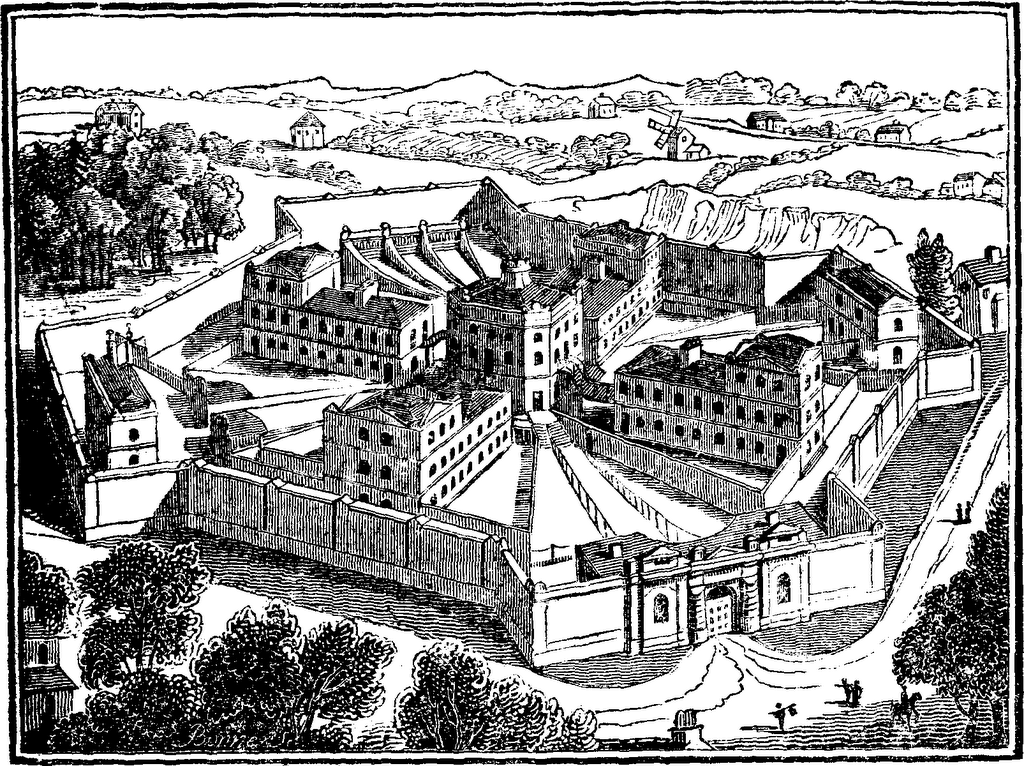
At last, just after New Year, 1869, Sheward cracks. He hurries down to Walworth Police station and asks to see a policeman. They're surprised to see a successful businessman breaking down in tears, telling them in detail how he'd committed a crime almost two decades earlier. He is arrested and shipped back to Norwich to be tried.

In prison, William realises that his crime has caught up with him at last. He tries to retract his confession, saying that he had been depressed and drunk that day. As depressed and drunk as he had been when he had picked up that razor, back in Tabernacle Street

But it's too late for William. The deed has been done, Light has shone in on the shadows in William's heart. Despite the directions of the judge, the jury find him guilty. At last, the judge stands and pronounces sentence. The dread words he had heard in his mind on Mousehold Heath:

'You will be taken from here to a prison, from there you will be taken to a place of execution, there to be hanged by the neck until you are dead."

And, soon after the trial, in a little room at Norwich City Gaol, William Sheward, now fifty-three, is hanged. He has paid for his crime. While he was able to evade the police, he could not evade his own conscience.

Crime Does Not Pay. Those who step into the shadows do not control their own steps.

Thursday, November 30, 2006

The Man Who Got Away With it: Two

It is the year 1851, William Sheward of Norwich, 35, has killed his wife in a fit of temper. After wandering Mousehold Heath, just outside the city, he resolves to return to his house and face the music.

Imagine his surprise, therefore, when he finds no policemen waiting for him. Only the cold, stiff body of Martha. And a thought creeps, unbidden, into the mind of the murderer. He realises that he might be able to get away with murder

He hides the body of his wife under the bed, and the next day he tells the neighbours that Martha has left him and returned to London. He's lucky, for Martha had been thinking of this, and had confided in the neighbours. The fatal row seems a good excuse, and she has not been reported as a missing person.

Sheward cuts the corpse into small pieces, and in a macabre act, he spreads them all over the city. At first the authorities believe that anatomy students are having a joke, but then it becomes obvious that all the pieces add up to a whole body. The parts are re-assembled to form a headless body. The authorities realise that they are dealing with a murder.

But Sheward's luck holds. The body is incorrectly aged as belonging to a girl in her late teens or early twenties, not the middle-aged Martha. Soon, William Sheward is able to sleep well at nights, except for the occasional nightmare.

He swears off alcohol and soon becomes a successful businessman. He is able to move out of the house of death in Tabernacle street, and soon marries again. Even so, he cannot fully shake off the memory of his dreadful act.

His second marriage brings old memories back, and Sheward's health begins to suffer. Soon, his wife is wondering just what is wrong with her prosperous husband. She recommends a trip away from the city, away from his properties, away from the pressures of business.

To London.

Wednesday, November 29, 2006

The Man who got away with it.

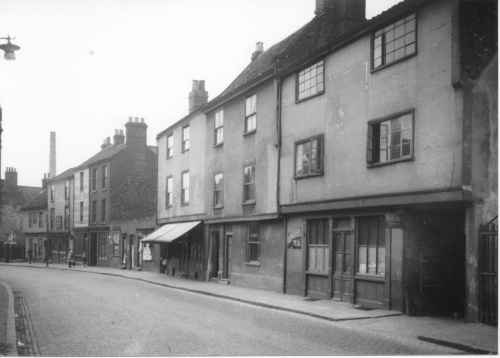
The city of Norwich, looking towards Bishopsgate. In the year 1851, on Tabernacle Street, a small blind alley off this street, there lived a couple whose life was just another blind alley, in a small and squalid house. William Sheward, aged 35, had married middle-aged Martha, who he had met in London. At first the marriage was happy, but when the first ardour of love faded, she seemed old and cruel. Her incessant nagging of her young husband caused William to crawl inside a bottle. The house was filthy and broken down, while William was chronically short of money. Martha's sole contribution to the housekeeping was to brow-beat her husband. Soon love turned to hate. Deadly hate.

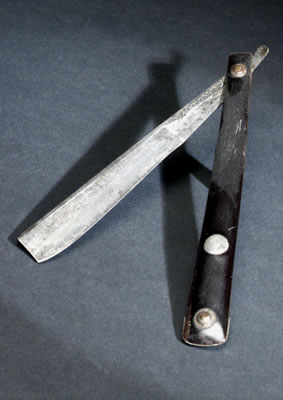
On Sunday June 15th 1851, when the congregation are gathering at the mighty Tabernacle chapel opposite the Shewards' little hovel, the temperature of the Shewards' appalling marriage reaches boiling point. After an argument about money, Sheward flees to the bathroom. Perhaps that might have been the last of it, but William's eyes at that night alight on his razor, lying by the basin. Rage boils up inside him, and he walks out of the bathroom, the razor in his hand.

His wife completely ignores him, sitting on the bed with her back to him, her manner offensive. This is the last straw. William sees red. And it's the easiest thing in the world to reach round and slit her throat. from ear to ear.

It's all over very quickly. Soon, the odious Mrs. Sheward is lying on the floor, in a rapidly spreading pool of blood. It's very red and all very real. Sheward is sorry now, but the deed is done. Martha is dead, and the dripping razor in William's hand has his fingerprints on it.

Sheward runs away, terrified by the knowledge of what he has done. He spent several hours wandering Mousehold Heath, just beyond Bishop's Bridge. He considers killing himself a few times, but he hasn't the heart to shed more blood, even his own. At last, he returns to the house of death, ready to surrender himself to the law.
He knows that he will swing for the terrible deed he has committed. He seems to hear the Judge's words. 'You will be taken from here to a prison, from there you will be taken to a place of execution, there to be hanged by the neck until you are dead."